Tuesday, December 20, 2011

iPads Finely Bound


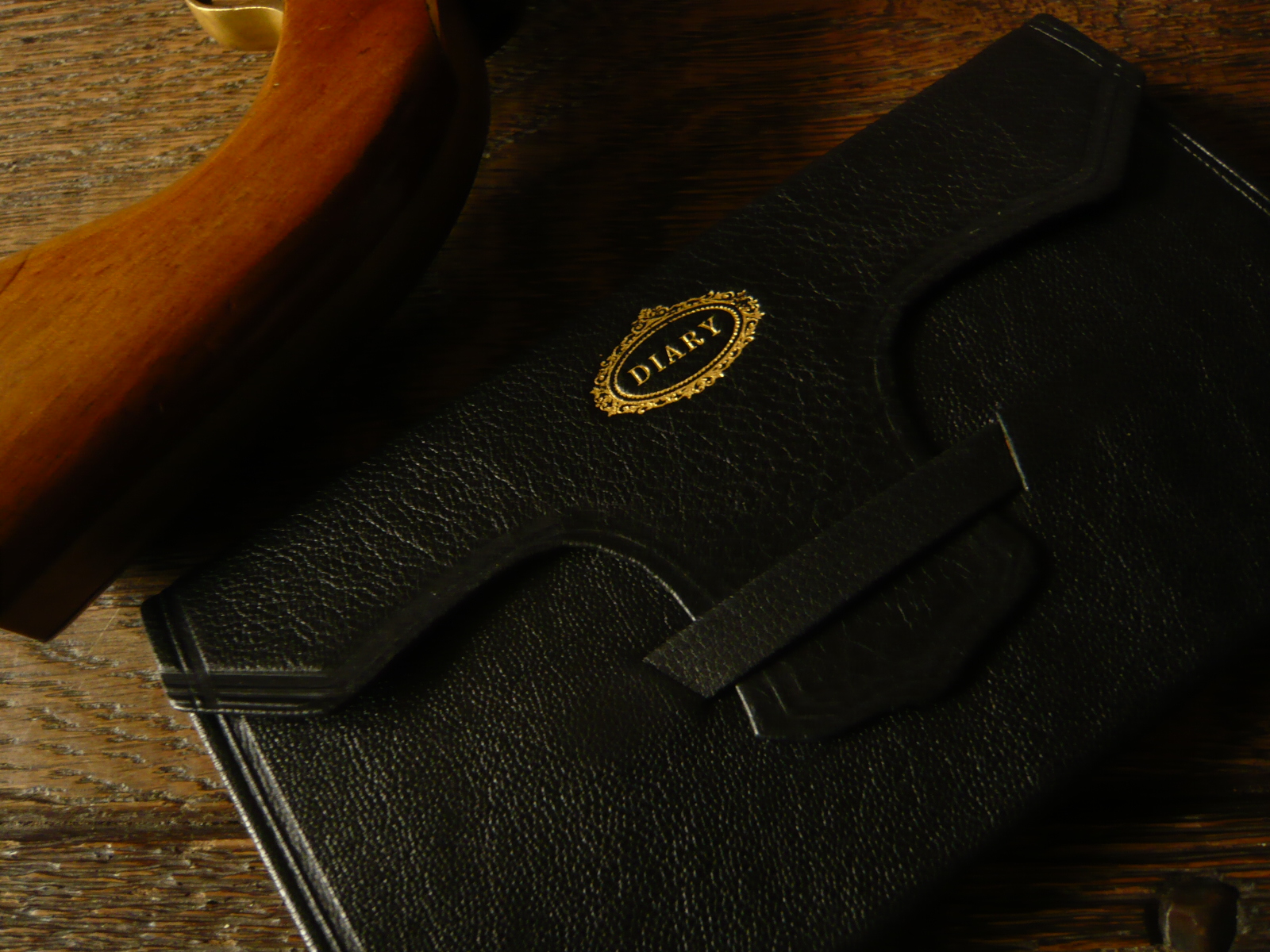
We've been working on several designs for iPad cases: a "Full" and a "Slim". They are made to look and feel like a fine antique book with raised bands, gold tooling and sumptuous materials. The Full features a hardwood frame slotted for access to ports and switches, with a slideout tray underneath for storing earphones, cords, stylus, etc. It's the size of a large book and (compared to the iPad) fairly bulky.

The Slim is no larger than many iPad cases on the market but beautifully made of fine leathers and handmarbled papers.

At present (meaning until we get a large order from StuffMart and farm it all out to China), every case is built to order, with a variety of woods, leathers, and decorative papers available. The two pictured feature deep brown morocco leather spines and corners, the Slim's leather tray fashioned from olive-colored kangaroo. They can be titled however desired, personalized with name, company, or ostensibly clever phrases like "Luddite's Revenge" pictured above. Inquire for prices.

Tuesday, May 31, 2011

Literary Reconstruction


I've begun working on an important collection of several 17th and 18th century poets, or at least their literary remains. Currently on the bench are two 1674 editions of George Herbert's "The Temple" and a 1720 2-volume quarto edition of the poetical works of John Milton. A partially disbound copy of "The Temple" was pulled, mended, resewn, bound, and tooled in the photos above. A second copy needing no text repair was rebound in dark calf, the last picture above. (Pictured lying on "Walton's Lives", in for a reattachment of its boards. The Milton volumes below need new spines, having been rebacked in weak sheepskin sometime last century, those weak joints finally splitting apart. The original headbands were gone, having been replaced with a thick cord tucked into the headcap, so they're being resewn in the photos posted here. The new headbands will be age-toned to match their respective edges (top edges are usually dirtier than bottom) and will go unnoticed (as they should) when the new leather has been worked on. A cloth inner joint was visible and machine-made pastedowns had just been applied over the originals, so those layers were removed all the way back to the original leather turnins. The original leather has been treated with a consolidant, all later materials eliminated, and labels saved in case they're worth reusing. (That'll be decided when new leather is in place and the final results can better be anticipated.) More pics as we progress!

Speaking of bookbinding....

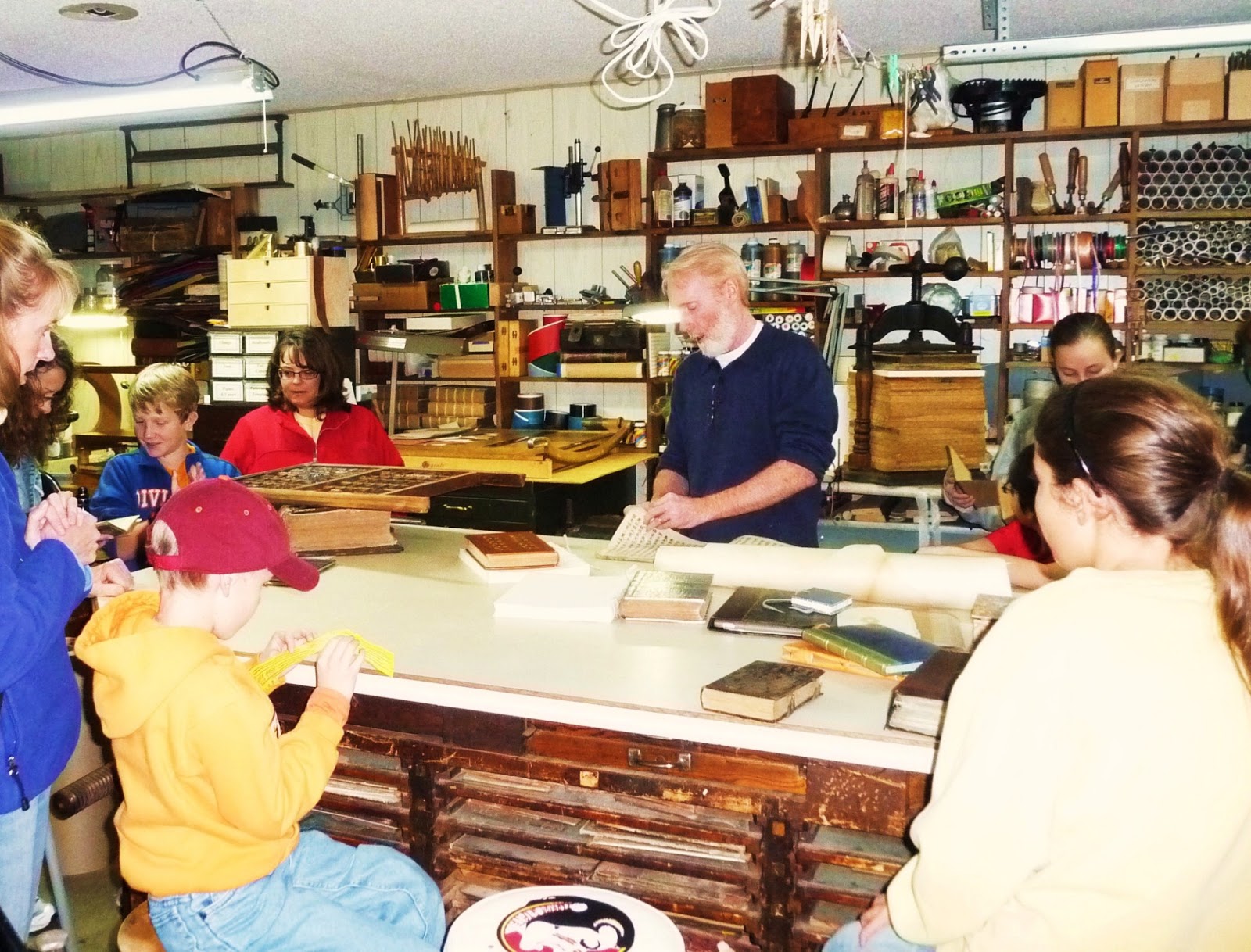
I enjoyed a visit to Nashville last weekend, giving a lecture on bookbinding at their public library's Special Collections Center. With 3 librarians and a number of book artists in attendance, it was a lively crowd, and the hour-and-a-half went by quickly. We talked about a variety of techniques, the future of the book, the demise of trade binderies and apprenticeships and the sad effect on quality, and even covered (briefly) the advertised topics!

Wednesday, May 18, 2011

An Unusual Ledger Construction


Some years ago I happened on several rolls of a canvas-backed slitted paper in a bankrupt bindery in North Dakota. They had at one time made large ledgers for county records, and while hauling away a treasure trove of tools, I saved a few of their ledgers and the rolls of material.

This past month, a ledger arrived for repair that used this now unusual method; the cloth being folded into a continuous Z and each section being sewn to the peaks. It's an interesting way to solve a real problem: how to make a strong flexible binding that will open ALL the way to the fold. I have "Portland Guard" stuck in my head as the name of the hinge material, but would love to hear from anyone that can tell me more! The pictures show a view from the spine, an intact ledger opened, the "Portland Guard" unrolled, and a view of what remains of the spine after the sections have been removed for mending.

Thursday, January 20, 2011

Cook's Voyages

Half the fun in the restoration business is working on great books few of us ever get to see. These photos are of a 1779 2-volume edition of Captain James Cook's "Voyage toward the South Pole, and around the World. Performed in His Majesty's Ships The Resolution and Adventure." The textblocks were fairly tight, though some fold-out maps needed mending. New headbands were sewn over round cores and the whole rebound in sprinkled calf. I'm trying out new calf, still searching for a replacement of Pearce's inimitable (and no longer available) vegetable-tanned calf. This is from Franz Hoffman in Germany and tooled very nicely, though it wasn't fun at all to pare. (The animal is a little older and the hide much tougher.)


Wednesday, January 5, 2011

Flowers Personified: A Leather Rebacking


The hand-colored title page and a closeup of new leather turn-ins.

Cloth joints oversewn and a picture of the detached spine The close-up shows new leather worked under old and new headcaps formed, prior to color touchup and blending..


Close-ups of the reattached spine, with new leather running from the reattached spine to the triple gold lines.


"Flowers Personified" is an unusually beautiful volume, handcolored throughout "with 52 female figures adorned with flower costumes." The textblock was in very good condition but, as is typical with books of this period (mid 19th century), there was virtually nothing holding the boards on beyond the thin covering leather and paper inner joints. As a result, both spine and boards were detached.
After cleaning the back of the textblock, linen joints were oversewn. This is a somewhat invasive procedure, but is at times invaluable for catching up loose sections front and back and for providing solid support across the joints. (The debate can rage on in the comments if you like.) To finish preparation of the textblock, the spine was relined with a new hollow.
The leather on the boards was lifted (you can see the cut right next to the three gold lines) and matching black morocco was worked around the spine and underneath the original sides. The original spine was cleaned from the backside (extra layers of lining material removed), headcap areas were thinned, and then it was laid back over the new spine. New leather was blended with the old and though the camera flash is merciless, the repairs are fairly invisible to the untrained eye. This type of rebacking is perhaps the most common "surgery" performed by book doctors, and similar techniques are used for clothbound books.

Monday, December 27, 2010

Gold Foil: Imitation or Genuine?


If you've been at the craft for very long, chances are you've picked up a few unidentified rolls of gold foil. Cloth bindings aren't very particular; they like cheap foil as much as the real thing. If you use imitation gold on leather, however, it doesn't take very long before the fake gold loses its luster and turns a corroded green.


In February, I took a box of unidentified foil and stamped a sample card with each one. In just a few months, I had proof of which foils were imitation and, as an added bonus, had a sample card to help choose between different shades of the real stuff. In the picture, stamps 1 through A are from February, with 1, 6, 7 & 8 being fake. The photo doesn't really capture this well. The imitation foils are now black, which can be rubbed off with a thumbnail to reveal a dull metallic underneath. The genuine foil is bright and crisp and with a variety of shades from almost white through a reddish-orange tint.
I tested a second batch (B-H) on December 16th. C and H look dark in the photo, but that's just from the flash. Pretty slow and very low tech, but time reveals true character! (Insert wise proverb here...)

Monday, July 19, 2010

Wedding Guest Book for Korean Bride


This wedding guest book for a Korean bride was sewn on double cords laced into boards, top edge gilt, and bound in alum-tawed goatskin with patterned silk sides, handsewn headbands of white and yellow over a round core. It stands upright in a fitted box with ribbon to lift it out and a large compartment for cards and other memorabilia. The box is covered in creme patterned silk with bone closures. Also pictured is the maid of honor (the binder's wife) and our daughter in traditional Korean hanboks


Sunday, April 11, 2010

Hammond Glider Saw, Rouse Angle Cutting Saw


Hammond Glider Saw ($500) and Rouse Angle Cutting saw ($120), both wired for 110. Inquire with bob@gildedleafbindery.com, (865) 621-7923. All offers (trades too) will be seriously considered.

Friday, March 12, 2010

Rebacking a Clothbound book with Leather


Though our usual goal in restoration is to keep the book as original as possible, we'll occasionally take liberties when doing so will make for a better book. In this case, the original spine was missing, and any new cloth spine would, despite careful coloring and aging, have had a difficult time matching perfectly. So, we opted for a complete contrast, choosing a dark leather and tooling in a style reminiscent of the original covers. The boards were split and the leather was tucked between them without disturbing the inner paper joints.

Saturday, February 20, 2010

Blue Morocco


11" by 15" springback ledger. Guestbook with several pages of text and 500 blank pages. Bound in blue morocco and tooled in blind and gold.

Wednesday, January 13, 2010

ESV Study Bible in Dark Brown Morocco


ESV Study Bible rebound in dark brown morocco, leather floral onlays (red and green) on front cover. Cloth inner joints, marbled endpapers, Scripture verse tooled around inner dentelles. "The Delight Of His Eyes" reference is from Ezekiel and is used in describing his wife.


Tuesday, December 1, 2009

Dragons and Black Leather


Dragons and Black Leather
Here’s a “non-traditional” approach to leather that actually harkens back to the earliest book form. Featuring a wrap-around cover with a leather tie, this modern version in black leather was made for the local Harley Davidson motorcycle shop. Sewn on three linen tapes, it has hard covers, decorative endpapers, a matching top edge, and an inlaid leather dragon. A simpler version with a pre-sewn textblock and simple embossed dragon is also available.