Showing posts with label restoration. Show all posts

Tuesday, March 17, 2015

Miniature Books published in Kingsport, Tennessee


At only 9/16" x 3/4" (19x14mm) these are the smallest books we've worked on. They were published by the Training Division of the Kingsport Press in Tennessee and came with a brass bookshelf, two covers brittle and detached and one cover missing. They're real books (142 pages for George Washington) with leather turned in and gold tooling.  We made new leather covers of morocco pared paper thin and laid original parts over for two, tooling the third. The titles are Extracts from the Autobiography of Calvin Coolidge, 1930; Washington, His Farewell Address, 1932; Addresses of Abraham Lincoln, 1929. The last picture puts them in context with a somewhat large book also on the bench: Hayden's Geographical and Geological Atlas of Colorado. 27" high by 20.5" wide.

Monday, August 12, 2013

Vintage Reenactor Journals: Civil War, Lewis & Clark

We're working on a series of historically accurate journals, capturing historical periods we hope will be of great interest to reenactors. The above journal is a faithful reproduction of Lewis & Clark's Codex A and B, roughly 6" by 3" oblong sketchbooks they used for recording maps, wildlife, and descriptions of their journeys. We're working on a dedicated website (www.vintagebookbinding.com)  but feel free to contact us if you find them here!


This small pocket diary's title page reads, "Ladies' Diary. Being a repository for daily musings and reflections on the domestic life." Its leather spine and embossed cloth sides covers the period from roughly 1850 to 1890.


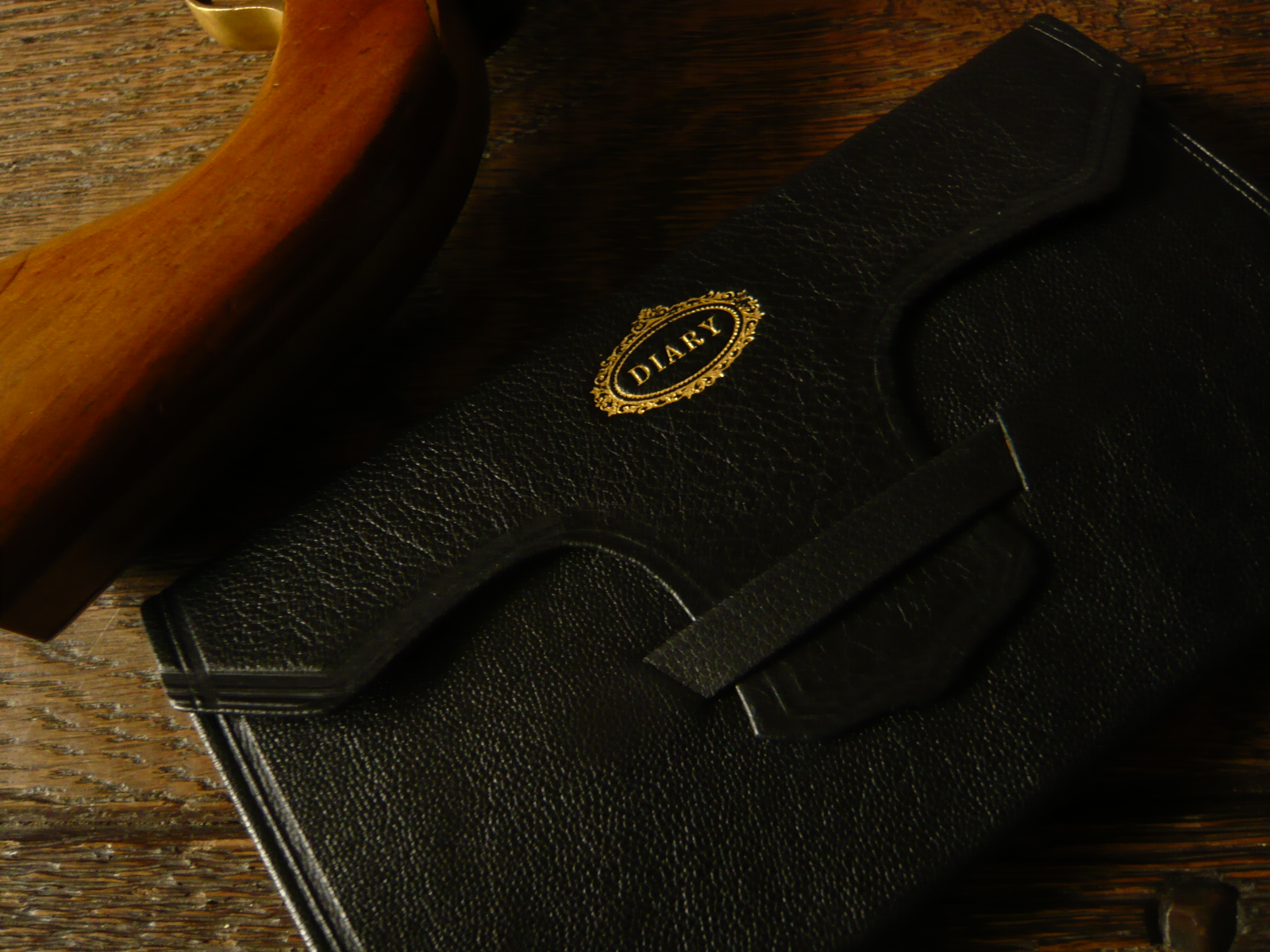
We're especially proud of these Civil War pocket diaries. With interest tables, postage rates, travel times, advice to soldiers (such as "Grow your beard at least 3" to avoid disease") and an expanding pocket for pay stubs and receipts, these are exact replicas of the diaries many soldiers carried. The period-correct flap closure, vegetable tanned leather, hand-marbled paper, choice of fonts and the feel of the paper (an ivory vellum finish as close as we could get to the original), these are the genuine article 150 years later. We hope they become an essential part of the reenactor's kit and spend time on the same ground won and lost during that horrible conflict.


Wednesday, January 5, 2011

Flowers Personified: A Leather Rebacking


The hand-colored title page and a closeup of new leather turn-ins.

Cloth joints oversewn and a picture of the detached spine The close-up shows new leather worked under old and new headcaps formed, prior to color touchup and blending..


Close-ups of the reattached spine, with new leather running from the reattached spine to the triple gold lines.


"Flowers Personified" is an unusually beautiful volume, handcolored throughout "with 52 female figures adorned with flower costumes." The textblock was in very good condition but, as is typical with books of this period (mid 19th century), there was virtually nothing holding the boards on beyond the thin covering leather and paper inner joints. As a result, both spine and boards were detached.
After cleaning the back of the textblock, linen joints were oversewn. This is a somewhat invasive procedure, but is at times invaluable for catching up loose sections front and back and for providing solid support across the joints. (The debate can rage on in the comments if you like.) To finish preparation of the textblock, the spine was relined with a new hollow.
The leather on the boards was lifted (you can see the cut right next to the three gold lines) and matching black morocco was worked around the spine and underneath the original sides. The original spine was cleaned from the backside (extra layers of lining material removed), headcap areas were thinned, and then it was laid back over the new spine. New leather was blended with the old and though the camera flash is merciless, the repairs are fairly invisible to the untrained eye. This type of rebacking is perhaps the most common "surgery" performed by book doctors, and similar techniques are used for clothbound books.

Friday, March 12, 2010

Rebacking a Clothbound book with Leather


Though our usual goal in restoration is to keep the book as original as possible, we'll occasionally take liberties when doing so will make for a better book. In this case, the original spine was missing, and any new cloth spine would, despite careful coloring and aging, have had a difficult time matching perfectly. So, we opted for a complete contrast, choosing a dark leather and tooling in a style reminiscent of the original covers. The boards were split and the leather was tucked between them without disturbing the inner paper joints.

Monday, September 7, 2009

Rebacking a 19th Century half-calf book

Flora Rustica, from the library of Charles Haddon Spurgeon. This is a good example of the rebacking of a 19th century half-calf volume. The boards were detached and portions of the spine were missing. Sometimes (particularly with ornately tooled family Bibles or important publisher's cloth bindings) we'll insert new material under the original and put the old spine right back on. On other occasions, replacing the aged leather is more appropriate. This time, we built new boards with new leather corners and spine, used the original cloth sides and leather spine label, and then tooled the new leather to match the old. The result is a book that looks very much like an immaculately preserved original. Spurgeon's bookplate was, of course, carefully lifted from the original pastedown and reattached.


Of interest to some may be the scrap paper the last binder used to line his boards underneath the cloth. They are the paper covers (wraps) and ads from another natural history volume. I'll often use scrap paper from our printer tray. which I'm sure will make interesting reading for someone in 2110.

Tuesday, July 21, 2009

Aged Headband Cloth


I've found the last bit of a great cloth for making 19th century headbands. (Discontinued by the factory.) It features blue stripes and a stained/aged beige that makes the cloth look 100 years old; a perfect match for many books including family Bibles. It can be more deeply aged if needed, but looks great for many uses as is. It's 100% cotton, thin enough to form neatly over round or square cores (light shirt weight, not bed ticking). A 3" by 45" strip is $7 postpaid; enough for a lot of books. The top picture shows a similar cloth headband still attached with new material behind. The 2nd photo gives a sense of the stained/aged appearance. What's not easily apparent from the photo is that the "white" portions are not just beige, but have soiling and stains as part of the design. It's an unusual cloth; sort of like the ratty jeans so popular among today's callow and unkempt youth. If you'd like a much larger piece to make a pre-soiled filthy new shirt, just let me know. : )

Thursday, July 9, 2009

Rebinding a Family Bible

Our usual goal when restoring a family Bible is to reuse the original spine and boards. Repairs are hidden underneath the original materials and the book retains the look and feel of a period piece. When the covers are missing or unsalvageable, the best approach is not always clear. Because the sculpted boards and the blocked gold tooling are an irreplaceable part of the book's history, there's no easy way to recreate the look and feel of an antique Bible from the mid to late 1800's. While sculpting boards and having metal dies made for tooling is possible, it's fairly expensive.

These covers suffered heavy water damage, shrinking the leather and exposing large areas of the boards beneath. We were able to salvage the center portion of the leather, sculpt new boards to receive it, and suggest the correct period by a combination of blind and gold tooling.


It's far more common for the spine to be missing, and we face the same difficulties in matching intricate tooling without scanning the original and making new dies. Here's a recent effort that suggests the ornate original and blends well with the original boards.

Wednesday, June 24, 2009

The Springback


We've had some interesting books in from a county archive dating back to the early 1800's. In addition to mending and resewing the textblocks, we rebuilt some very interesting historical bookbinding structures. The most unusual is the springback, which features a hard curved spine that wraps around the textblock. When the book is opened, the pressure of that curved spine board throws the pages open all the way to their inner margin, a great convenience for the clerk. When closing, the "spring" opens slightly and then as it flexes back shut, pulls the textblock back into that curved hollow. They are rarely seen today, and require a number of specialized reinforcements across the inner joints. We built a model years ago as a visual aid, but typically take note of how each book was built and simply copy the original structure as we rebind.


Besides the structural uniqueness (much of which remains hidden), many ledgers from this era feature beautiful leatherwork with extra colored panels and tooling, both in blind and gold.